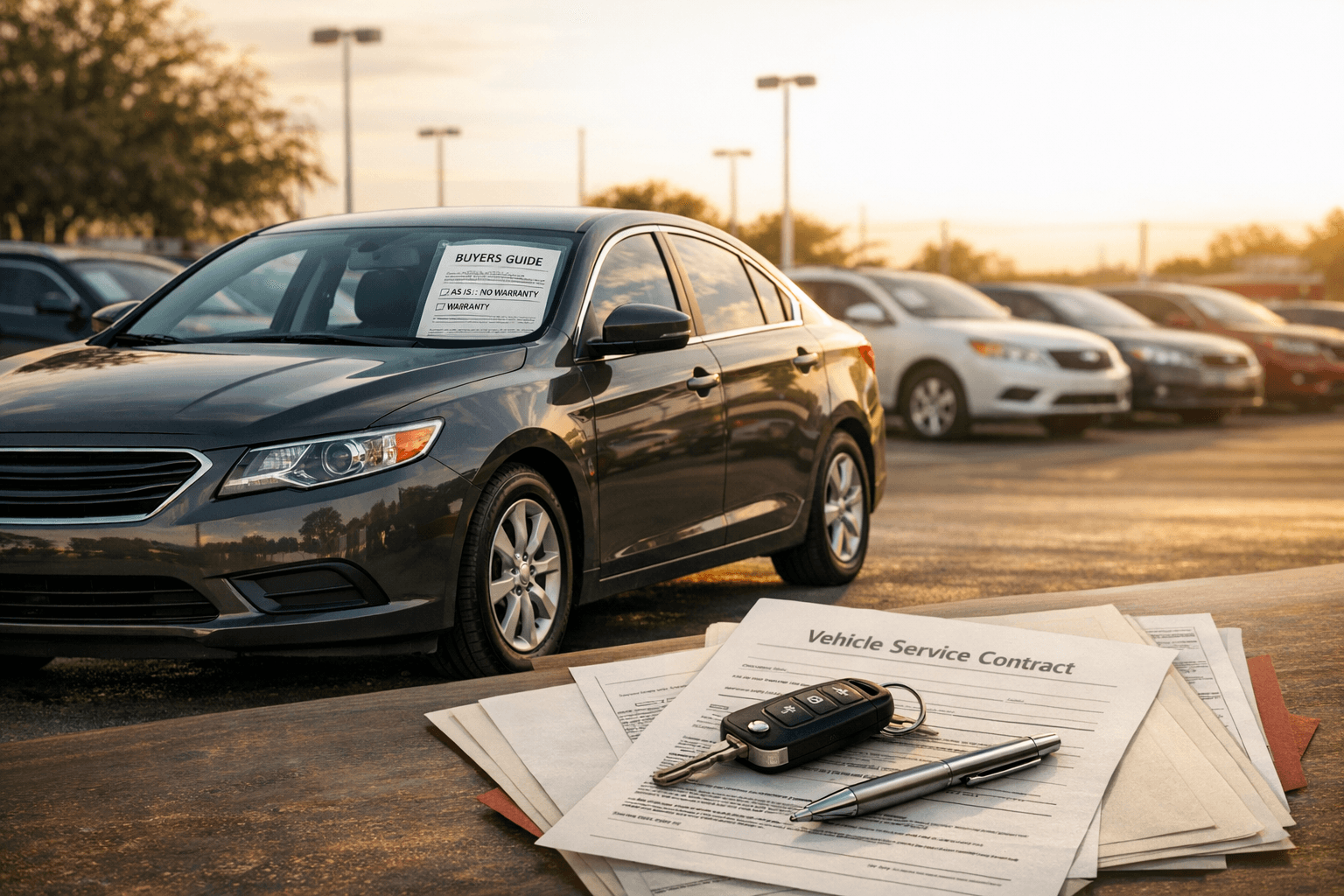
As-Is Used Car Risk in 2026: What the Buyers Guide Really Means and Why a Service Contract Can Change the Deal
"As is" has a way of shutting buyers down. They hear it and assume the rest of the deal is simple: if the car breaks, too bad. That is not a good enough reading of the paperwork, and it is exactly how people miss the part that matters.
The real control document is the FTC Buyers Guide on the car. That form tells you whether the dealer is offering a warranty, whether a service contract is available, and whether the store put any promises in writing. It also points buyers to vehicle history and recall checks for a reason. Those are not side quests. They are part of basic used-car diligence.
This topic is different from our extended-warranty post. That one is about whether a service contract is worth the money. This one is about the sale itself: what "as is" actually means, where dealers still have to be precise, and why one extra contract can change your legal position fast.
What the Buyers Guide is really doing
Warranty status
The guide has to say whether the car is being sold "as is," with implied warranties only, or with a dealer warranty. That choice is not filler. It changes the risk you are taking on.
Negotiated changes
If the dealer changes the warranty terms during the deal, the Buyers Guide is supposed to reflect that final version. The paperwork on the windshield matters more than buyers think.
Service contract disclosure
The guide is also where you see whether a service contract is being offered for an extra charge. That matters because the contract can change implied-warranty exposure on covered systems.
History and recall reminder
The FTC Buyers Guide tells shoppers to get a vehicle history report and check for open safety recalls. If the federal form says to do it, treat it like required homework, not a suggestion.
The easy mistake is focusing on the sales contract and forgetting the form attached to the car. The FTC is pretty direct about this: the Buyers Guide is part of the deal, and spoken promises are hard to enforce unless they get written down.
What "as is" does and does not mean
An "as is" sale means the dealer is not promising to handle repairs after the sale. That part is real. You should assume the store is trying to move repair risk onto you.
But "as is" does not mean every other part of the deal stops mattering. It does not erase title problems. It does not excuse contradictory paperwork. It does not make spoken promises magically enforceable. It does not make open recalls less real. And it definitely does not turn a bad vehicle history into a harmless one.
- It does not replace a VIN report. If the car has flood history, a rebuilt title, odometer trouble, or theft recovery signals, "as is" just means you may be buying that mess with fewer repair options later.
- It does not replace a recall check. NHTSA says recall repairs are free, but they still take time and can stall ownership plans the week you buy the car.
- It does not save vague promises. If a salesperson says "we'll fix that light later," get it on the Buyers Guide or somewhere equally clear. Otherwise you may be left arguing over memory.
That last one is where buyers lose. The store says something reassuring in person, the contract stack says something colder, and the customer only realizes the gap when the first repair estimate lands.
The paperwork conflicts that should slow you down
-
The Buyers Guide says one thing and the contract says another.
If the guide shows a warranty but the retail contract says "as is," that is not a detail to ignore. The documents need to match before you sign.
-
The dealer talks like they are covering repairs but refuses to write it down.
That usually means the promise is weaker than it sounded in the showroom.
-
The service contract is presented like a factory warranty.
A service contract is its own product with its own exclusions, deductible rules, repair process, and cancellation terms. If the store blurs that line, read harder.
-
The car is sold "as is" but the dealer rushes you past inspection, history, and recall checks.
That is backwards. The less repair support you have after the sale, the more important pre-sale diligence becomes.
I would not call these automatic deal-killers. I would call them reasons to stop acting rushed. An "as is" sale is exactly where your paperwork discipline has to improve, not loosen up.
Why the 90-day service-contract rule matters so much
This is the part many buyers never hear clearly. The FTC says that if you buy a service contract from the dealer within 90 days of buying the used car, the dealer cannot remove implied warranties on the systems covered by that contract.
That does not mean every problem becomes free. It does mean the legal picture may be better for you than the phrase "as is" suggests. If the contract covers the engine, for example, you may also pick up implied-warranty rights on the engine under state law.
What buyers hear
No coverage
The car is "as is," so the dealer owes nothing.
What the contract can change
Covered systems
A dealer-sold service contract within 90 days may restore implied-warranty protection on the systems it covers.
What you still need
Paper trail
You need the contract, coverage terms, exclusions, and written proof that it is actually in effect.
This is exactly why I do not like vague dealership talk around warranty products. A service contract is not just a side add-on. In the wrong hands it is sold like comfort. In the right hands it is a document you read closely because it changes the legal and repair picture.
A smarter as-is checklist before you sign
-
Read the Buyers Guide before the finance office starts stacking papers.
Check which warranty box is marked, whether a service contract is disclosed, and whether anything the dealer promised is actually reflected in writing.
-
Run the VIN report before negotiating repair promises.
History first. Promise talk second. There is no point negotiating around a car you should have rejected anyway.
-
Check NHTSA recall status yourself.
Open recalls are free to repair, but they still cost you time, delivery certainty, and leverage if you discover them after closing.
-
Get an independent inspection if the dealer will allow it.
The FTC Buyers Guide itself points buyers there. That is a clue. Use it.
-
If a service contract is part of the deal, read it like a finance contract.
Look for covered systems, exclusions, deductibles, cancellation terms, waiting periods, and where repairs must be done.
Most bad "as is" deals are not caused by one giant lie. They happen because the buyer lets three or four smaller assumptions slide by at once.
Where VINSCRIBE fits
VINSCRIBE helps at the exact moment "as is" becomes risky: before you decide whether the car is worth the paperwork and repair exposure.
- Check title brands, loss history, theft signals, odometer risk, and ownership context before you treat the dealer's story as complete.
- Use one report to pressure-test whether a service contract is covering a basically solid vehicle or a problem you are about to inherit.
- Catch history issues early enough to walk away before the store turns the conversation into monthly payment math.
That is the practical order: read the Buyers Guide, inspect the car, run the history, check recalls, then decide whether "as is" is a fair trade-off or just a fast way to buy someone else's problem.