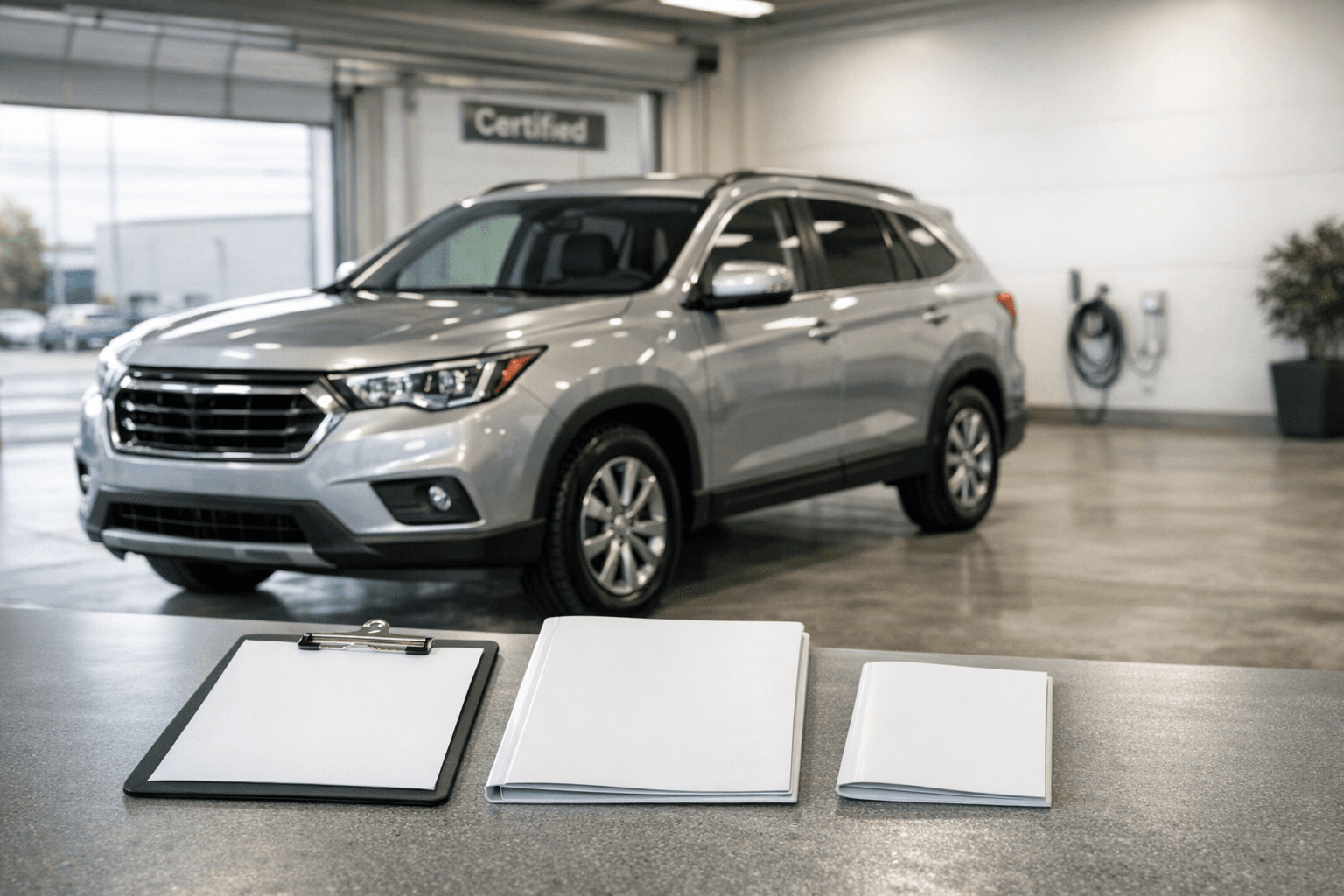
Certified Pre-Owned Risk in 2026: What a CPO Badge Does and Does Not Tell You
Certified pre-owned is one of those phrases that calms people down a little too fast. You see the badge, you hear "multi-point inspection" and "factory-backed warranty," and suddenly the car feels safer than the rest of the lot. Sometimes it is. Sometimes you are mostly paying for a nicer story and a thinner layer of risk.
The important thing is not whether CPO is real. It is real. Manufacturers and dealers really do create eligibility rules, inspection checklists, and warranty benefits. The problem is what buyers start assuming after that. A lot of people hear certified and mentally translate it to clean history, no prior damage worth worrying about, no open recall issues, and no need for a serious outside inspection. That leap is where the bad decisions start.
This is a different topic than flood cars, rebuilt titles, or former rental inventory. Those posts focus on what happened to the car. This one is about what buyers think the badge means after the car is already standing there polished, parked up front, and priced above the non-certified version two rows over.
What CPO usually buys you
If you strip away the sales language, certified pre-owned usually means four things:
Eligibility rules
The car has to fit a brand program on age, mileage, and sometimes model-year limits. Ford says Gold Certified vehicles must be Ford models with fewer than 80,000 miles and no more than six years old.
Inspection checklist
There is usually a documented inspection process. Ford advertises a 172-point inspection for Gold Certified vehicles. Toyota advertises a 160-point inspection for Toyota Certified Used Vehicles.
Warranty coverage
The car often comes with some combination of comprehensive and powertrain coverage. That is real value, but only if you read the actual coverage terms instead of stopping at the headline.
A price premium
This is the part nobody forgets to charge for. The badge usually costs money. Your job is figuring out whether the inspection, warranty, and dealer accountability justify the extra spend on this specific VIN.
That last line matters because there is no single CPO standard across the whole market. Programs vary by brand, warranty length, inspection depth, and benefits. You are buying into a program, not into a universal definition of "safe."
What the badge does not promise
It does not replace an independent inspection
The FTC says an independent mechanical inspection is a good idea even if the car has been certified, inspected by the dealer, and sold with a warranty or service contract.
It does not replace a vehicle history report
FTC guidance also says vehicle history reports are not substitutes for inspections. That cuts both ways. An inspection is not a substitute for title, loss, theft, and mileage history either.
It does not mean every warranty question is simple
Coverage length, covered systems, exclusions, deductibles, and transfer rules still matter. The word warranty is not the same thing as "everything important is covered."
It does not give you permission to stop checking recalls
NHTSA says a VIN recall search tells you if a specific vehicle has an unrepaired recall. Ford's own CPO certification page also carries a recall notice telling shoppers to check recall status.
This is the whole article in one paragraph: CPO can reduce some risk, but it is not a permission slip to stop doing the rest of the work.
Why buyers overread the badge
I think buyers overread CPO for a very normal reason: it feels like somebody else already worried for you. That is emotionally convenient. It also makes it easier to overlook the exact car sitting in front of you.
-
The premium creates false comfort.
If a certified version costs more than the non-certified version, people start assuming the extra money automatically bought a cleaner history and fewer surprises.
-
The checklist sounds more complete than it is.
A 160-point or 172-point inspection sounds airtight. In practice, you still need to know what those points cover, what standards were applied, and what the program does not promise.
-
Shoppers blur warranty, condition, and history into one thing.
They are not one thing. A car can qualify for a CPO program, come with useful warranty coverage, and still be a VIN you should scrutinize harder before paying the premium.
The four places CPO buyers still get burned
-
They never read the warranty document.
The FTC's used-car guidance says to get the warranty in writing and review what is covered, who fulfills it, and how repairs are handled. Buyers who skip that step usually find the real boundaries later, when the repair bill shows up.
-
They stop asking about prior repairs because the dealer says it passed inspection.
Inspection passed is not the same answer as "Tell me about prior body repair, wheel damage, glass replacement, ADAS recalibration, or paintwork on this VIN."
-
They assume recalls are already handled.
That may be true. It may also not be fully true yet. NHTSA's VIN tool exists for a reason, and it is quick enough that there is no excuse for skipping it.
-
They pay the premium without comparing the non-certified version.
Sometimes the CPO math works. Sometimes the non-certified version plus an excellent inspection and a realistic service budget is the smarter deal. You do not know until you compare.
Questions worth asking the dealer out loud
- Can I see the actual certification checklist and reconditioning invoice for this VIN?
- What would make this vehicle lose its certification if it were inspected again today?
- Was there any prior body repair, paintwork, wheel repair, glass replacement, or calibration work that I should know about?
- Is there any open recall, service campaign, or manufacturer communication attached to this VIN right now?
- What is excluded from the certified warranty, and who pays if I need diagnosis before a claim is approved?
- How much more am I paying for this car than the same model without certification on your lot or in your market?
A strong CPO deal usually survives these questions. A weak one starts sounding vague fast.
Where VINSCRIBE fits in
VINSCRIBE is useful here because it keeps the badge from doing too much of the thinking for you:
- It gives you VIN-level history context before you treat the certification premium as justified.
- It helps you catch title, loss, theft, and mileage signals that a glossy showroom presentation can blur.
- It gives you a cleaner fact pattern for recall checks, inspection questions, and negotiation.
That is the practical value. You are not trying to prove every certified car is risky. You are trying to keep a certification badge from becoming a substitute for judgment.