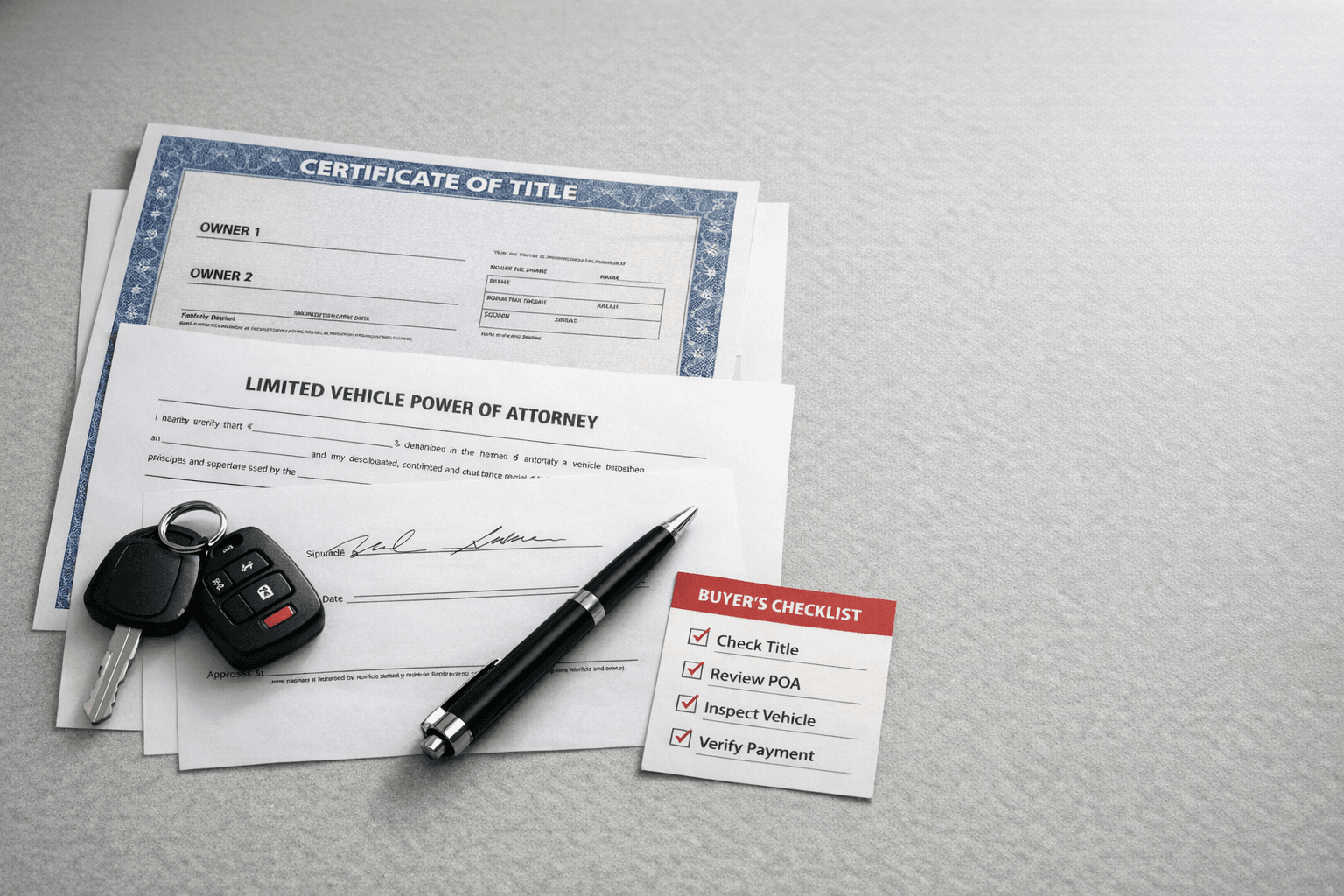
Two Names on the Title in 2026: How to Buy Safely When One Owner Cannot Sign in Person
A private seller says the car belongs to both spouses, but only one could make it today. Or an adult child is handling the sale because the other owner is overseas. Or the seller waves a folder and says, "My ex already knows about it, we're good." This is the part where buyers talk themselves into a paperwork problem because the car seems worth it.
Two names on the title do not automatically kill a deal. They do change the rules. The question is no longer just whether the car is clean. The question is whether the person in front of you can transfer ownership in a way your DMV will actually accept.
This is not the same problem as a missing title, an estate transfer, or a seller who still owes the bank. Here, the trap is shared ownership. One owner may be legitimate. That still does not mean one owner can sign for both.
Why co-owner deals go sideways
The car is present
The authority may not be
Keys, registration, and possession can make the deal feel more settled than the title really is.
One missing signature
Can stall registration
The car can be in your driveway while the title transfer dies at the counter because the ownership chain is incomplete.
Buyer mistake
Trusting the story
People hear divorce, deployment, illness, or travel and stop verifying the actual transfer authority.
I would treat this like a control-of-signature deal first and a price negotiation second. If the title cannot move cleanly, everything else about the car becomes secondary.
The first thing to read is the ownership setup, not the seller's explanation
The title itself usually tells you more than the seller's summary. Look at the exact owner names, how they are joined, and whether there is any lender still attached.
- Two owners with an "and" relationship: That often means both owners need to sign, or one needs state-accepted authority to sign for the other.
- Two owners with an "or" relationship: That can be easier, but do not freestyle it. Confirm your state and the issuing state will accept the transfer path the seller is proposing.
- One owner present, one owner "unavailable": That is where a real vehicle power of attorney, remote notarization path, or mailed signature process becomes the whole deal.
- One owner no longer involved personally: Separation, divorce, military duty, illness, and work travel are all common stories. None of them override title requirements by themselves.
The cleanest deals are boring. The title setup is clear, the signer authority is obvious, and nobody needs you to be "flexible" with the paperwork.
When a power of attorney is real, and when it is just a story
A legitimate vehicle power of attorney can solve this problem. A vague promise that someone else gave permission does not.
What you want to see
- The absent owner's full legal name
- The exact vehicle or VIN tied to the authority
- The attorney-in-fact named clearly
- Signatures that match the title names
- The form or format your state DMV actually accepts
What I would not trust
- A text message saying "my wife said it's fine"
- A generic note with no VIN or title details
- A scanned signature the seller cannot explain
- A form from a different state with no DMV confirmation
- A seller who gets irritated when you ask how the authority works
Virginia's VSA 70 is a good example of what "real" looks like. It specifically exists to let an attorney-in-fact sign title paperwork for the owner when registering or transferring ownership. California has its own REG 260 form for vehicle and vessel transfers. That is the point: the authority needs to be tied to the vehicle-transfer process, not improvised on the hood of the car.
The four questions that usually expose whether the deal is clean
-
Who is on the title, exactly?
Do not accept "both of us" as enough. Read the front of the title and match every name to government ID or signing authority.
-
Why is one owner not signing in person?
The reason may be perfectly normal. You still need the paperwork path that covers it.
-
What exact form or process will the DMV accept?
Not what the seller thinks. Not what their cousin did once. The actual state process for this title, in this ownership setup.
-
Does the VIN history fit the ownership story?
Run the report before you untangle the signature logistics. If the car has title-brand issues, theft history, or state-transfer weirdness, you may be solving the wrong problem.
A seller with legitimate paperwork can usually answer those questions without turning it into a drama scene. Maybe it takes a day. Fine. That is still better than buying first and learning later that one owner never actually authorized the transfer.
Proceed, pause, or walk away
Proceed
Both owners are available to sign, or the absent owner has valid DMV-accepted authority on file and the VIN history matches the seller's story.
Pause
The explanation is plausible, but the DMV form is still being confirmed, one signature is pending, or the lender and co-owner setup are both in play.
Walk away
The seller cannot show the title, the absent owner will not appear anywhere in the paperwork trail, or the plan depends on you paying now and trusting the signatures later.
That last version is the one I would avoid every time. A clean-looking SUV is not worth months of arguing over whether the transfer was valid.
Where buyers get burned
- They assume a married couple can always sign for each other automatically.
- They accept a generic power of attorney without confirming it is valid for vehicle transfer.
- They focus on the absent owner and forget to check whether a lienholder is also still attached.
- They send a deposit before they know who has legal authority to finish the transfer.
- They spend all their energy on the title signatures before checking whether the VIN history reveals a bigger reason to leave.
That last one matters. VINSCRIBE is useful here because it lets you sanity-check the car before you waste time solving the co-owner paperwork puzzle. If the history is already ugly, there is no prize for becoming an expert in someone else's signature logistics.
A short closing checklist
- Read the title front carefully and identify every owner named on it.
- Match all present signers to government ID.
- Verify the absent owner's authority path before money moves.
- Confirm whether the title state and your registration state require anything extra.
- Check for open liens, not just co-owner issues.
- Run the VIN history report before final negotiation.
- Do not rely on "we'll get the second signature later."
If the seller can clear that list, the deal may be fine. If they cannot, the safest move is usually the least exciting one: leave and buy a different car.