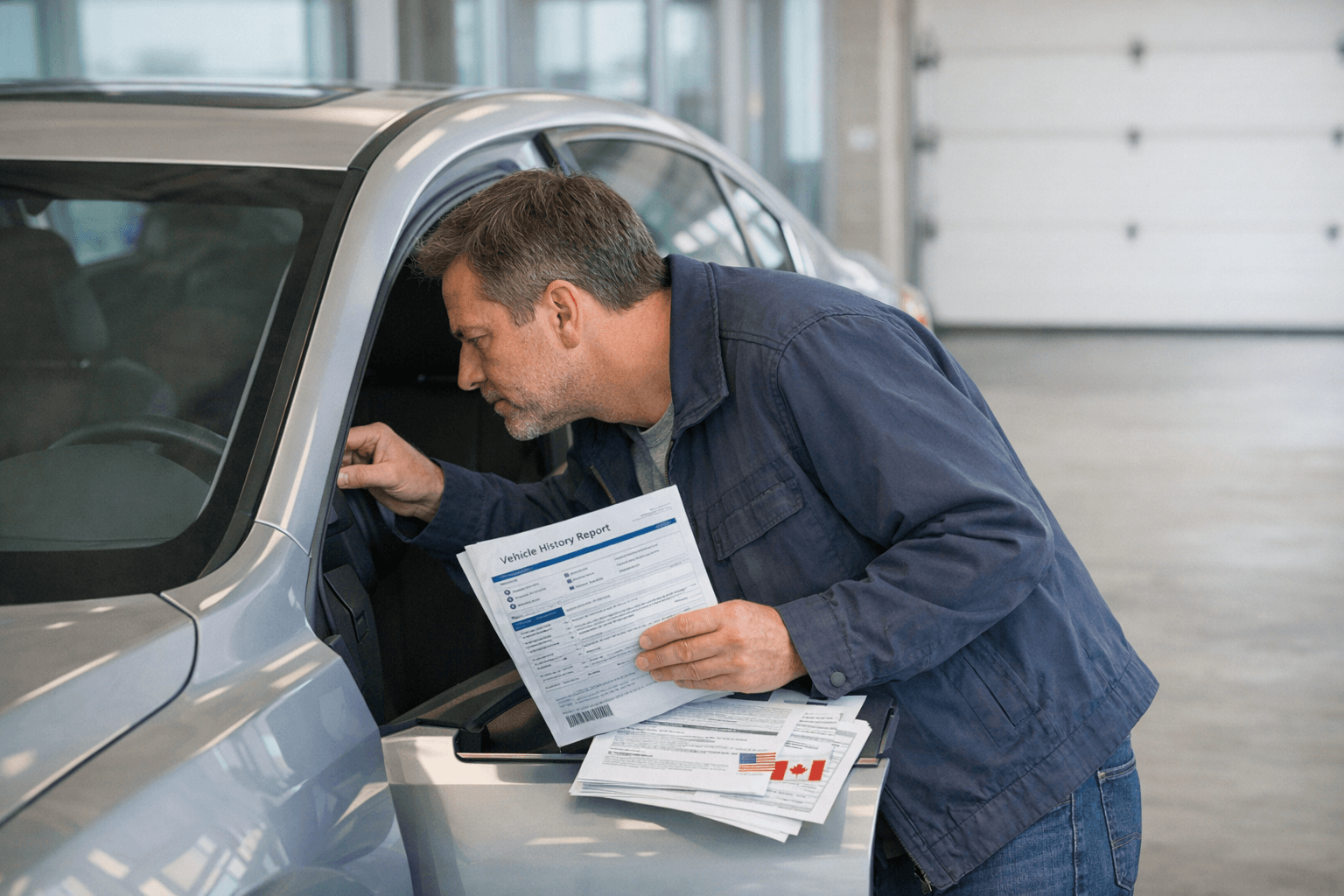
How to Tell if a Used Car Was Imported From Canada: A Private-Buyer VIN Checklist
As of 2026-03-08, Canadian-market vehicles still move into the U.S. used-car supply through trade-ins, relocations, dealer sourcing, and cross-border resale. That does not automatically make them bad buys. Some are excellent vehicles. The problem is that buyers often do not realize the car started life in another market until paperwork, mileage history, warranty questions, or resale friction show up later.
If you are wondering how to tell if a used car was imported from Canada, the right approach is not guesswork. Use a repeatable verification process: check the VIN history available to you, inspect certification labels, compare mileage units across the record, and confirm recall or warranty details before you pay.
This guide is built for private buyers who want a fast, practical checklist before handing over a deposit.
Why Canadian-Import History Matters
Mileage Risk
km vs mi
A Canadian-market car may show kilometer-based service or title records, which can confuse buyers when the dash or listing is presented in miles.
Compliance Check
Label First
NHTSA and EPA import guidance both center on vehicle certification and emissions compliance, so labels and paperwork matter more than seller claims.
Resale Friction
Future Appraisal
If you cannot document the cross-border story now, a future buyer, dealer, or lender may discount the car later.
Takeaway: the risk is usually not that the car is “from Canada.” The risk is buying one without a clean explanation of certification, mileage history, and documentation.
What Can Be Different on a Canadian-Market Vehicle
- Mileage presentation. Service records, prior listings, and inspections may be recorded in kilometers while U.S. buyers think in miles.
- Certification paperwork. Imported vehicles should have a defensible compliance trail, not just a verbal explanation from the seller.
- Recall and warranty workflow. Some warranty or recall questions are easiest to resolve only after you verify the VIN directly with the manufacturer.
- Future resale questions. A dealer or future buyer may ask for the same proof you skipped today, especially if the history timeline looks unusual.
None of these are automatic deal-breakers. They are verification points. A good used-car purchase becomes a bad one when the seller cannot explain the car's market history clearly and consistently.
How to Check in 10 Minutes Before You Commit
-
Run the VIN history before the test drive.
Use VINSCRIBE first to review the ownership chronology, title events, and mileage history available in the report. You are looking for a timeline that makes sense, not a perfect story invented at the curb.
-
Ask for a photo of the title and current registration.
If the vehicle crossed the border recently, the title sequence or registration timing can help explain when it entered the U.S. market.
-
Inspect the certification label in the driver-side door area.
NHTSA import guidance treats certification labels as a key part of determining whether a vehicle conforms to applicable requirements. Get a clear photo, not a vague description.
-
Check the under-hood emissions label.
EPA import guidance is similarly documentation-driven. If a seller cannot provide clear label photos, you do not yet know enough to buy confidently.
-
Compare odometer units to the history record.
Look for unit-switch confusion: a record trail in kilometers paired with a listing that talks only in miles deserves a closer review.
-
Run the VIN through NHTSA recall lookup and contact the OEM.
Confirm open recalls and ask the manufacturer how warranty or recall support is handled for this exact VIN in the U.S.
-
Make the seller explain the cross-border story in one sentence.
A legitimate seller usually has a simple answer: trade-in, relocation, auction purchase, or dealer acquisition. Evasive answers are a risk signal.
Red Flags That Should Slow You Down
- The seller avoids sending label photos. If you cannot inspect the door-jamb and emissions labels, you are missing core compliance evidence.
- The mileage trail does not convert cleanly. Sudden jumps, odd rounding, or unexplained shifts between kilometers and miles deserve a second look.
- The title timeline feels too recent or too thin. A short U.S. history with no good explanation is not automatically bad, but it is not automatically safe either.
- The price is meaningfully below similar listings. A discount can be real. It can also be compensation for a paperwork story the seller knows will spook careful buyers.
- The seller says “it's basically the same car” and stops there. That is not documentation. That is a sales line.
Decision Framework: Proceed, Verify, or Walk Away
Proceed
The VIN history is coherent, the labels are present, the seller's explanation is consistent, and the OEM recall or warranty answers are clear.
Verify More
The vehicle may be fine, but you still need better photos, clearer mileage-unit evidence, or manufacturer confirmation before moving forward.
Walk Away
The seller avoids documentation, the history timeline feels inconsistent, or the discount depends on you ignoring unanswered questions.
The core rule is simple: buy proof, not stories.
What VINSCRIBE Helps You Confirm
VINSCRIBE is not a magic “Canadian import detector,” and it should not be presented that way. It helps you review the reportable VIN history available to you on the U.S. side of the deal, then decide what still needs to be verified through labels, seller paperwork, and the manufacturer.
- Review ownership chronology so the seller's cross-border story can be tested against the report timeline.
- Spot title events or mileage patterns that deserve a closer look.
- Share one report with a co-buyer, mechanic, or family member so everyone is reviewing the same VIN history.
That combination matters. A good VIN report narrows the questions. Labels, paperwork, and OEM confirmation close the loop on whether the vehicle originated in another market.