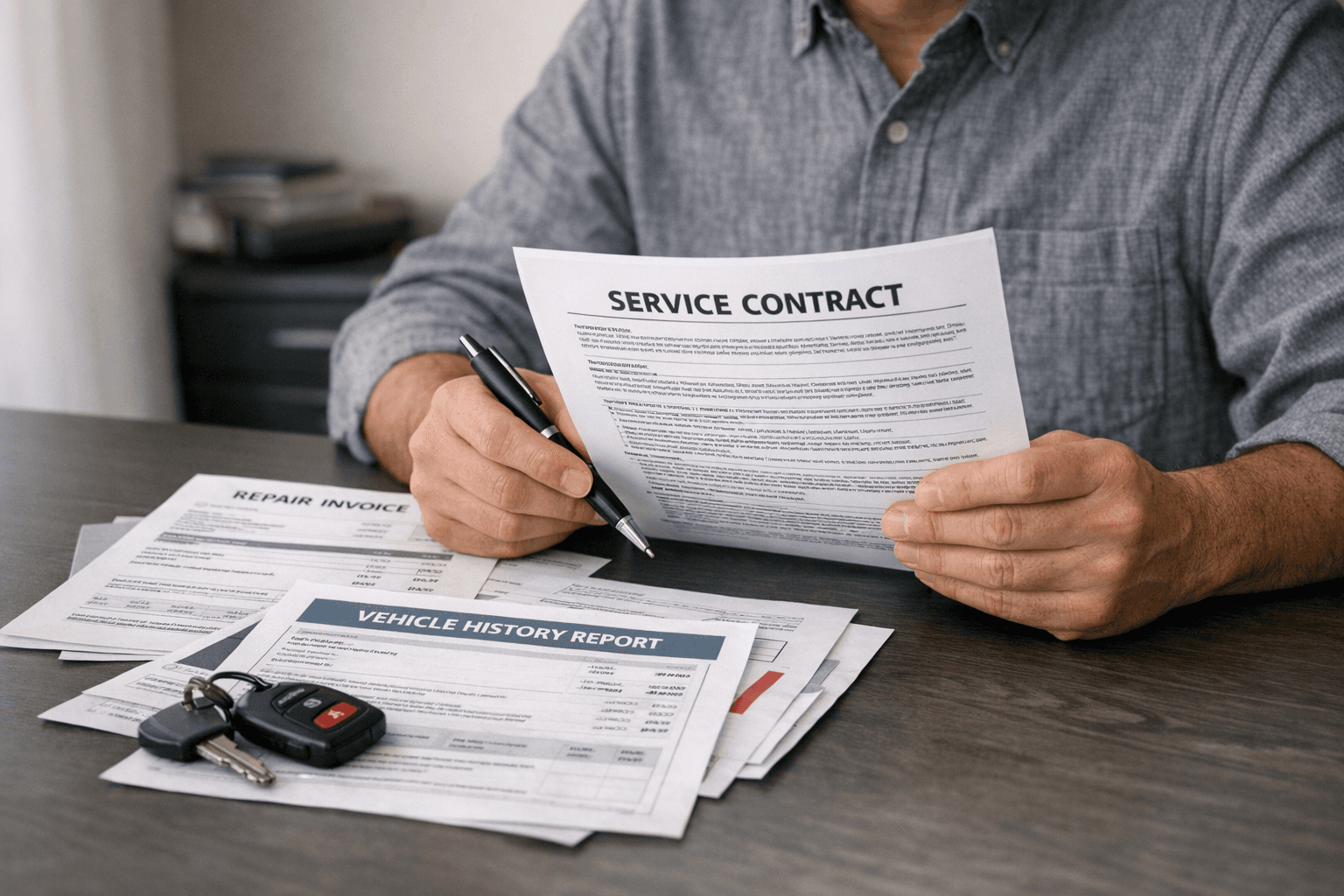
Used Car Extended Warranty in 2026: When a Service Contract Helps and When Vehicle History Makes It a Bad Bet
Dealers love selling service contracts when the buyer is tired. You have already picked the car, lived through the payment dance, and signed half a forest's worth of paper. Then somebody says, "For a little more a month, you can protect yourself from expensive repairs." That pitch works because the fear is real. Repair bills are real too.
The problem is that buyers often make the service-contract decision before they have made the vehicle decision. That is backwards. A contract might help on the right used car. On the wrong used car, it can become one more financed add-on attached to a history you did not understand well enough.
This is not the same conversation as GAP insurance or CPO marketing. GAP protects loan balance exposure after a total loss. CPO is about the dealer or manufacturer certification story. A service contract is its own product, with its own exclusions, claims process, cancellation rules, and opportunities for regret.
What you are actually buying
An "extended warranty" on a used car is usually a service contract sold separately from the car. The FTC is very direct about this: a service contract is not the same thing as a warranty that came with the vehicle. That sounds technical until you need coverage and discover the distinction matters.
The car
May be sold as-is
The Buyers Guide tells you whether the dealer is offering a warranty or selling the vehicle without one.
The contract
Costs extra
You usually buy it separately, and if it is financed, you pay interest on it too.
The catch
Coverage is narrower than the pitch
Exclusions, deductibles, repair-network rules, and claim approvals decide whether it feels useful later.
That is why I would never buy the contract first and ask questions later. The useful version is the written agreement, not the verbal summary from the finance office.
When a service contract can actually make sense
Sometimes the product is doing a real job. I take it more seriously when the car is expensive to repair, the buyer plans to keep it for a while, and the contract terms are specific enough that you can tell what is and is not covered.
- High-cost components are a real concern. Turbocharged engines, air suspension, complex infotainment, hybrid components, and dense ADAS hardware can turn one failure into a painful bill.
- You are buying late enough in the vehicle's life that factory coverage is thin or gone. This is where buyers start feeling exposed.
- You have read the claim rules. If the contract clearly states covered systems, deductible structure, approved repair paths, and cancellation terms, that is a much better sign than "bumper-to-bumper" talk with no paperwork behind it.
- The price is sane relative to the risk. A reasonably priced contract on a clean-history vehicle can be defensible. An overpriced one on a shaky car usually is not.
The point is not to dunk on every service contract. It is to stop pretending they are all equal.
When vehicle history should make you slow down
This is where VINSCRIBE matters. The service contract may look attractive precisely because the car has more risk baked into it than the listing lets on.
Prior major damage
A car with collision history, structural repairs, flood damage, or a branded title may be more likely to create "pre-existing condition" fights later.
Commercial or hard-use history
Former rental, rideshare, fleet, or police use can mean more wear than the odometer alone suggests.
Open recalls or unresolved campaigns
If the car still has recall or campaign work hanging over it, fix that first before you decide what protection product you need.
Questionable valuation
A contract does not rescue an overpriced used car. It can just help finance the mistake over a longer period.
The ugly version of this deal is easy to picture. You overpay for a used car with prior damage, finance a pricey service contract on top, and later find out the repair you were worried about lives inside an exclusion or gets labeled pre-existing. That is a rough way to discover you bought reassurance instead of protection.
Five questions worth asking before you sign
-
What does the Buyers Guide say about the car itself?
Start there. If the vehicle is being sold as-is, understand that you are leaning even harder on a separate contract.
-
Which systems are covered, and which failures are excluded?
Ask for the actual agreement. Look for deductibles, waiting periods, tear-down authorization language, and exclusions for pre-existing damage or poor maintenance.
-
Where can repairs be done?
Some contracts restrict repair shops or require prior approval before work begins. That matters if the car breaks down far from home.
-
How do cancellation and refunds work?
If you sell the car early or pay the loan off, find out how unused value gets refunded, to whom, and on what timeline.
-
What does the VIN history say that could change this decision?
Run the report before you buy the product. Title brands, damage clusters, theft recovery, mileage inconsistencies, and prior commercial use all change the risk picture.
A simple framework: buy it, shop it, or skip it
Buy it
The car has a clean, believable history, the contract terms are clear, and the price lines up with the risk of ownership.
Shop it
You want extra protection, but the dealer's price, exclusions, or refund rules feel weak. Compare manufacturer-backed and third-party options before committing.
Skip it
The vehicle history is shaky, the agreement is vague, or the contract cost is just being folded into an already stretched deal.
That framework is intentionally boring. Good. Most bad used-car outcomes start when buyers let the conversation get more emotional than specific.
What this means for VINSCRIBE users
VINSCRIBE helps you decide whether the vehicle is worth protecting in the first place:
- Run the VIN before the finance-office pitch starts so you are not making add-on decisions in the dark.
- Use title, damage, theft, odometer, and recall context to judge whether the car's risk profile matches the price and the contract.
- Separate two questions that often get mashed together: "Is this a good used car?" and "Is this a good service contract?"
I would rather walk into the warranty conversation with a clean report and a sharp pencil than with optimism and no documentation. The second version is how buyers end up paying extra for protection they may never be able to use.