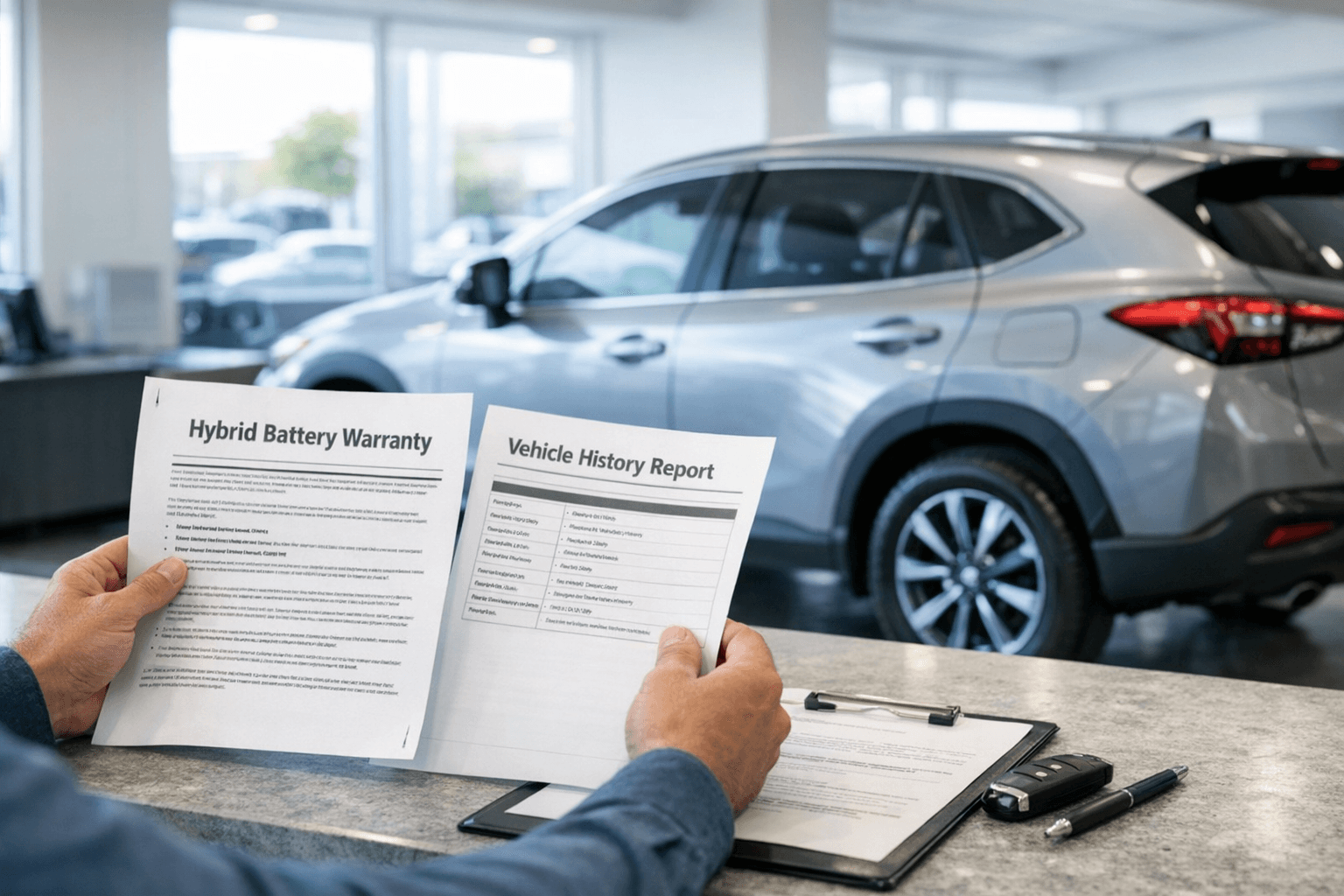
Used Hybrid Battery Warranty Risk in 2026: How to Verify Second-Owner Coverage Before You Buy
Hybrid shoppers hear some version of the same line all the time: "Don't worry, the battery is under warranty." Sometimes that is true. Sometimes it is half true. Sometimes it is the kind of sentence that sounds comforting right up until you call the dealer with the VIN and learn the warranty clock started years earlier, the branded-title history changed the picture, or the coverage only looked generous for the first owner.
This is different from the battery-health article we already published. Battery health asks whether the pack is aging well. Warranty risk asks who is still paying if it does not. Those are related questions, but they are not the same question, and buyers mix them up constantly.
If I were shopping a used hybrid tomorrow, I would treat battery-warranty claims the same way I treat "clean title" claims: useful, but not self-proving. You want the exact VIN, the in-service date, the actual warranty booklet, and a clean enough vehicle history that the coverage still means something.
Why second owners get tripped up here
Clock start
Earlier than you think
Warranty time usually starts on original retail delivery or date of first use, not the day you bought the used car.
Coverage type
Not all battery promises are the same
Factory hybrid coverage, federal emissions coverage, California emissions coverage, and dealer service contracts all play by different rules.
History risk
Paperwork can kill value
A salvage, rebuilt, or total-loss history can change what warranty language is still usable even if the car drives fine today.
This is where buyers get lazy because the battery discussion feels technical. The truth is more boring than technical. Most mistakes happen because nobody checked dates, title status, and state-specific warranty rules carefully enough.
The part most shoppers misunderstand
A lot of buyers hear "8 years or 80,000 miles" and assume the whole hybrid battery must be federally protected. That is not how the EPA describes the federal emissions warranty. EPA says the federally specified major emissions components are the catalytic converters, the electronic emissions control unit, and the onboard diagnostic device. That warranty applies to used vehicles too, but it is not a blanket promise that every hybrid traction battery issue is covered the same way.
Then California and other CARB states complicate the story. CARB's consumer warranty sheet says PZEV and TZEV vehicles can carry enhanced emissions coverage of 15 years or 150,000 miles for emissions-related parts, while the battery or other energy-storage device has its own 10-year or 150,000-mile coverage period. That can be meaningful on some used hybrids, but only if the vehicle and the state history actually line up with that certification path.
So the first question is not "Does this hybrid still have battery coverage?" The better question is "Which warranty are we even talking about, and does this VIN still qualify?"
What current warranty language looks like in the real world
Toyota example
Toyota's hybrid-battery warranty language for model-year 2020 and newer hybrids moved to 10 years from date of first use or 150,000 miles, and Toyota has publicly said that coverage follows subsequent owners too.
Older Hyundai example
Hyundai's older warranty books are a good reminder that "battery warranty" can split by ownership. For some 2019 hybrids, Hyundai gave original owners lifetime battery coverage, while subsequent owners dropped to 10 years or 100,000 miles from date of first use.
Branded-title problem
That same Hyundai handbook excludes vehicles declared total loss or issued salvage, rebuilt, or similar titles from warranty coverage. If you only remember one thing from this article, remember that one.
Dealer shorthand is not proof
A listing that says "battery under warranty" is just marketing language until a dealer service department confirms the actual remaining term for that VIN.
This is why I like used hybrids with boring histories. One-owner, clean-title, local-service cars are not just emotionally easier to buy. They are easier to verify. The battery warranty story tends to survive contact with reality better.
Your five-minute battery warranty check before money moves
-
Get the exact VIN and current mileage first.
Do not start with screenshots or a seller summary. You need the actual VIN because that is what the dealer service desk will use.
-
Ask for the in-service date.
Warranty age usually starts when the vehicle was first delivered or first put into use. A seven-year-old hybrid with one new owner is still a seven-year-old hybrid for warranty math.
-
Check the title and loss history before you celebrate the warranty.
If the car has salvage, rebuilt, total-loss, flood, or other major title events in the record, pause. Coverage language often gets uglier once branding enters the picture.
-
Confirm whether the car spent time in a CARB warranty state.
California-style emissions coverage can matter, but only if the vehicle certification and state history line up. This is not something to guess from a forum thread.
-
Call the brand dealer's service department with the VIN.
Ask what hybrid-battery coverage remains, what date and mileage it expires, and whether they see any notes that change warranty eligibility.
-
Ask for the actual warranty booklet or screenshot confirmation.
FTC guidance on used-car shopping is blunt about getting warranty information and promises in writing. That applies here too.
-
Price the car as if the battery warranty is gone until proven otherwise.
This is the safest negotiating posture. If the warranty checks out, great. If it does not, you already protected yourself mentally and financially.
Where VINSCRIBE helps, and where it does not
What VINSCRIBE can surface
Title brands, total-loss signals, ownership changes, recall context, theft history, and state movement that can change how believable the warranty story is.
What still needs direct confirmation
The exact remaining hybrid-battery term, the in-service date on file, and any OEM-specific exclusions or transfer rules tied to that VIN.
That split matters. VINSCRIBE helps you avoid wasting time verifying a battery warranty on the wrong car. It does not replace the final OEM warranty check, and it should not pretend to.
Buy it, price it harder, or walk away
Buy it
Clean title, believable state history, dealer-confirmed remaining battery coverage, and a price that still makes sense even if the pack is not immortal.
Price it harder
The car looks decent, but the battery-warranty story is fuzzy, partially expired, or dependent on state-specific assumptions you cannot fully verify in the moment.
Walk away
Branded-title history, dealer refusal to confirm coverage, missing in-service data, or a seller who keeps repeating "it should still be under warranty" instead of proving it.
The right used hybrid is still a great buy. I like them. But there is a huge difference between buying a hybrid with verifiable battery coverage and buying one with battery-related optimism. Those are not priced the same in my head.
Watch these before you trust the warranty pitch
These are useful because they stay practical. One is about which Toyota hybrids are worth shopping used. The other is a maintenance-focused reminder that hybrid ownership is still about filters, cooling, and system care, not just slogans about battery life.
What this means for VINSCRIBE users
If you are shopping a used hybrid, VINSCRIBE helps you do the battery-warranty check in the right order.
- Run the VIN first so you know whether title branding, total-loss history, or unusual state movement already makes the battery claim less trustworthy.
- Use the report during the dealer warranty call so you are not discussing coverage in a vacuum.
- Separate two questions cleanly: "Is the battery probably okay?" and "Would someone else still help pay if it is not?"
That is the whole play. A used hybrid can absolutely be the smart buy. You just do not want to overpay because somebody said the words "still under warranty" with enough confidence.
Sources
- FTC: Buying a Used Car From a Dealer
- EPA: Federal emissions warranty FAQ
- California Air Resources Board: California vehicle and emissions warranty periods
- Toyota USA Newsroom: Toyota extends battery warranty for model-year 2020 hybrids
- Hyundai USA 2019 Owner's Handbook and Warranty Information (PDF)